Tag: geology

  • From Strata to Self: A Geologist’s Journey Through Transformation


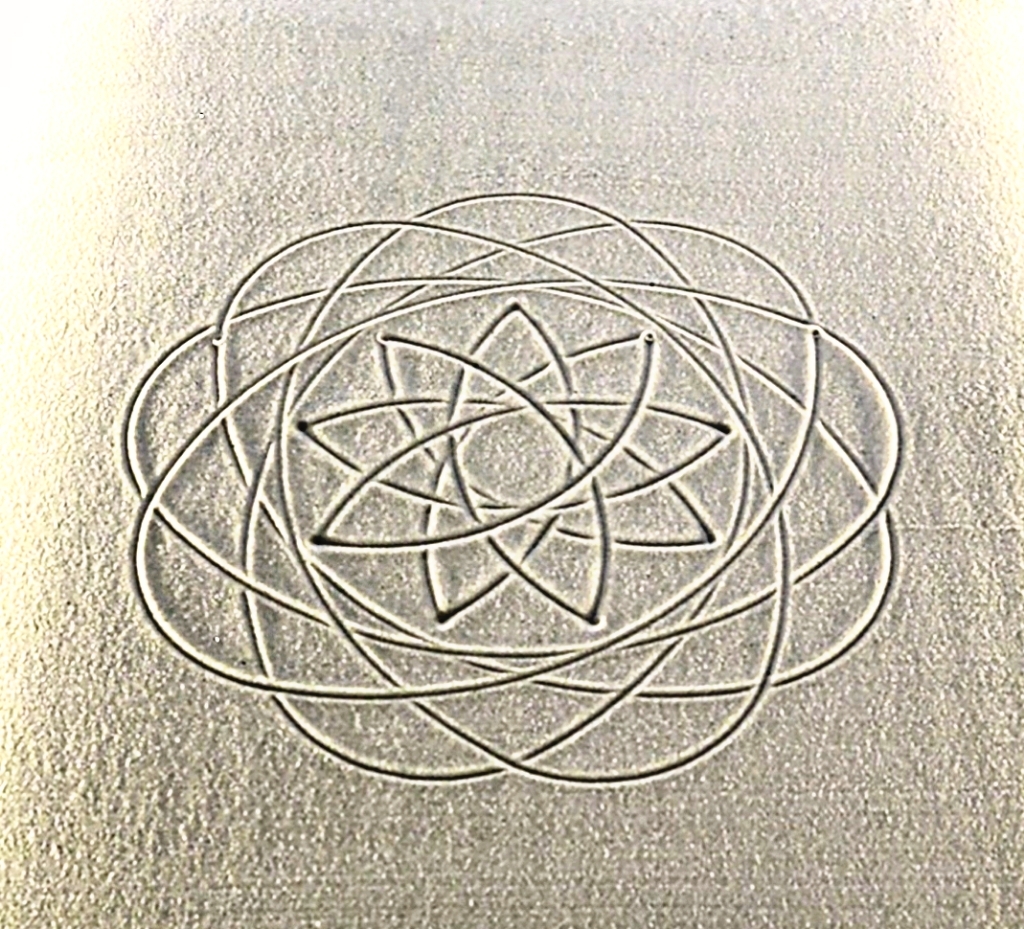
    Nine-pointed star and atomic orbital shells done in meditative sand art

    The Eternal Explorer: Unearthing Truths Within and Beyond

    Exploration is at the heart of everything I do. As a geologist, I’ve spent countless hours delving into Earth’s depths, searching for mineral treasures hidden in its layers. Yet, my most profound discovery has come not from uranium deposits, gold veins, or ancient rock formations but from within myself—a journey that began when I surrendered the reins of a self-driven life to a higher power. This pivotal change transformed not only my path but my perception of the world, allowing me to live in a new reality guided by inspiration and faith.

    The Baha’i teachings have illuminated this transformation for me. In the words of Abdu’l-Baha, “Religion and science are the two wings upon which man’s intelligence can soar into the heights, with which the human soul can progress.” Science without spirituality, or vice versa, can lead to imbalance; together, they create a harmony that has informed my journey both professionally and personally.


    Time as a Tapestry: A Cosmic Perspective

    Time has always fascinated me—not just as a geologist working with Earth’s immense timescales, but as an individual seeking spiritual truths. It begs the question: Is time linear, an immutable constant, or is it an experiential phenomenon that shifts with our awareness, much like tuning into frequencies on a cosmic radio? This idea—that our lived experience of time could be influenced by the channels we navigate, consciously or subconsciously—is as poetic as it is scientific. It ties together my passion for discovery with my spiritual faith, revealing a tapestry far richer than I ever imagined.

    The Baha’i writings resonate deeply with this idea of interconnected truths: “Science and religion must be in harmony.” In surrendering to my Higher Power, I’ve realized that time itself seems to have shifted—not in the external world, but within me. Living moment to moment, guided by inspiration and faith, has shown me that the present is where transformation truly occurs. What was once a race against time has become an intricate dance with it, every moment infused with purpose.


    Transformation Under Pressure: Lessons from Geology

    Geologists know that transformation takes time, pressure, and heat. Metamorphic rocks bear testament to this process—emerging renewed, transformed by their experiences in Earth’s depths. Similarly, my own metamorphosis came after years of self-driven living that led me to darker places. Five years ago, when I chose sobriety and surrendered my life to God, the Universe, my Higher Power—whatever name resonates most—I underwent a transformation every bit as dramatic as those rocks.

    This shift revealed a world that feels both new and familiar, as if seen through fresh eyes. The Baha’i scriptures capture this beautifully: “The reality of man is his thought… If a man’s thought is constantly aspiring towards heavenly subjects, he becomes holy; if on the contrary, it is directed to base desires, he becomes degraded.” Changing my thought patterns, surrendering to faith, and trusting inspiration have unearthed treasures within me I never knew existed.


    Trusting Inspiration: A Life Guided by Faith

    Professionally, my work as a geologist often requires trusting the process—digging deeper, following leads, and letting the Earth reveal its secrets in due time. This principle has mirrored my personal journey. Allowing inspiration to guide me moment by moment has taught me the value of surrender—not as a loss of control, but as an alignment with something greater.

    The Baha’i writings beautifully express this idea: “Let your thoughts dwell on the welfare of the world and the happiness of the nations… Strive that your actions day by day may be beautiful prayers.” By focusing on the present and trusting the flow of life, every action becomes a prayer, every discovery a revelation. This mindset has enriched both my work and my life in ways I could never have imagined.


    Living in a New World: The Explorer’s Revelation

    Surrendering to faith and embracing inspiration hasn’t just changed my life—it’s changed how I perceive the world itself. In allowing transformation to occur, I’ve found myself living in a completely new reality. It’s as if the layers of my old life have been stripped away, revealing a world brimming with possibility and beauty. This journey—guided by my belief in the harmony of science and spirituality—has been the greatest exploration of all.

    For me, exploration is more than uncovering minerals; it’s about uncovering truths, both earthly and eternal. This new world I inhabit reminds me every day of the interconnectedness of all things, and I embrace it with a spirit of gratitude and awe.



  • Naw Ruz 182 B.E.: A Time to Transform, Like the Earth Itself

    The arrival of Naw Ruz, the Baha’i New Year, brings with it a sense of renewal and reflection. Celebrated on the spring equinox, it marks not just a new calendar year but also a celestial alignment that reminds us of the intricate tapestry of time. As both a Baha’i and a geologist, I find a special resonance in this occasion—an opportunity to consider the dual realms of faith and the physical world.

    In the Baha’i teachings, Naw Ruz is a time to let go of what has outlived its purpose and to welcome the fresh possibilities that lie ahead. Similarly, in geology, the Earth itself embodies this process of constant renewal. Mountains rise and erode, minerals form and transform, and the tectonic plates shift and create new landscapes. Each moment in Earth’s timeline is a testament to the inevitability of change and the beauty that emerges from it.

    As we step into 182 B.E., we are reminded that every year carries with it the potential for expansion—of our horizons, our understanding, and our connections. But this growth often requires us to release the baggage of habits, fears, and attachments that no longer serve us. Just as the Earth’s surface is reshaped by the forces of erosion and uplift, we too must allow the currents of life to remold us.

    This Naw Ruz, I invite you to think about the layers of your own existence. What sediments of the past have hardened into unnecessary weight? What dormant potential lies waiting to be unearthed? Like a geologist examining a core sample, we can look into the strata of our lives and identify both the burdens to release and the treasures to embrace.

    And let us not forget the daily opportunities for transformation. Every sunrise offers the chance to refine our character, to turn challenges into learning experiences, and to contribute meaningfully to the world around us. Just as the Earth continuously evolves—building mountains, carving canyons, and fostering life—so too are we given the sacred gift of each moment to reshape and renew ourselves.

    As we move forward into this new year, let us carry with us the wisdom of both faith and geology: that change is a natural and beautiful process, and that each moment holds the potential for growth. Happy Naw Ruz to all who celebrate. May this year be one of discovery, renewal, and the courage to embrace both the known and the unknown.

  • You Are What You Think

    The idea that “you are what you think” may seem abstract at first, but it’s an observation I have repeatedly encountered, not only in my personal experiences but also in the dynamic patterns of the natural world. Just as the earth’s geological processes shape the terrain we see today, our thoughts—silent and unseen—shape the world we create for ourselves.

    As a geologist, I’ve spent countless hours in the field, surrounded by rugged mountains, ancient riverbeds, and shifting sands. These landscapes are testimonies to transformation—millions of years of erosion, deposition, and tectonic uplift. Much like the natural forces that carve valleys or build mountains, our inner thoughts and beliefs set processes in motion that sculpt the contours of our lives.

    Thoughts as the Foundation of Action

    In geology, the bedrock represents the foundation upon which everything else is built. Similarly, our thoughts form the bedrock of our actions. For example, when I step onto a new exploration site, the way I approach that landscape—whether with curiosity, skepticism, or optimism—directly impacts my findings. If I expect to discover nothing of value, my observations might become clouded, and I might miss signs pointing to mineral deposits. Conversely, an open and eager mindset often uncovers opportunities I might not have seen otherwise.

    This principle translates into everyday interactions. Imagine how our attitude, shaped by our internal dialogue, affects our communication with others. A small moment of self-doubt, left unchecked, might lead to hesitation or insecurity in speech. On the other hand, a simple affirmation—”I have something valuable to contribute”—can transform not just how we express ourselves but how others respond to us.

    Words: The Agents of Change

    If thoughts are the bedrock, words are akin to water in the geologic process. Water, though seemingly soft and fluid, has the power to erode mountains and carve vast canyons. Our words hold similar transformative energy. Speaking with kindness and authenticity has an unseen ripple effect. A casual compliment or word of encouragement can uplift a colleague, a friend, or even a stranger in ways we may never fully grasp.

    I often reflect on the conversations I’ve had with industry peers—discussions about diversity initiatives or sustainable mining practices, for instance. When I speak from a place of genuine conviction, others often feel inspired to take action. The simple act of voicing a thought carries a force akin to a flowing river, reshaping landscapes bit by bit.

    Actions: The Visible Record

    In geology, formations like stratified rock layers provide a visible record of past events. Similarly, our actions are the tangible outcomes of our inner workings. Just as the earth’s surface reveals its history through fossils and fault lines, our behavior reflects the collective influence of our thoughts and words.

    For me, this connection becomes clear in my efforts to promote diversity within the mining and exploration sector. The belief that inclusivity drives innovation led me to take action—whether it’s writing a blog post on the subject or celebrating women’s achievements in the field on International Women’s Day. These actions, though seemingly small, contribute to a broader, visible shift in the industry, much like sediments that accumulate to form new layers over time.

    The Unseen Magic

    Nature offers a profound metaphor for this “unseen magic.” While we often focus on what’s visible—the majesty of a mountain or the brilliance of a mineral vein—it’s the invisible processes beneath the surface that bring these wonders to life. Likewise, the energy of our thoughts, words, and actions works quietly yet powerfully to shape our reality.

    In recognizing this, we have the ability to become intentional architects of our lives. By cultivating positive thoughts, speaking with purpose, and acting with integrity, we harness the transformative forces that define who we are and how we interact with the world.

    So, as I reflect on the landscapes I’ve encountered and the lessons they’ve taught me, I leave you with this: What kind of world are you shaping with your thoughts today? Just as the earth’s processes require patience and persistence, so too does the practice of mindful thinking. But over time, the results can be extraordinary—a life built with intention and purpose, as steadfast and inspiring as the mountains themselves.


  • The Synergies Between AA and the Baha’i Faith: A Geologist’s Journey to Healing and Spiritual Fulfillment

    For someone who grew up rooted in the rolling plains of the Midwest, within a loving but imperfect Catholic family, life was a patchwork of lessons—some learned at the dinner table, others in the larger classroom of life. There was no shortage of moral guidance: the values of humility, generosity, and the importance of faith were woven into the fabric of my upbringing. Yet, as I ventured out into the vast and awe-inspiring landscapes as a geologist, uncovering the story of the Earth one rock layer at a time, I found myself searching for something deeper—something my career, achievements, and religious background could not fully satisfy.

    This is the story of how I, a self-described “drunk,” found harmony between the structured spirituality of Alcoholics Anonymous (AA) and the profound teachings of the Baha’i Faith, discovering a God I could understand and a path to genuine transformation.

    The Scientist’s Dilemma: Achievements Without Fulfillment

    As a geologist, my career has been nothing short of fulfilling in many ways. I’ve stood on mountaintops that took eons to form, unraveled the mysteries of ancient mineral deposits, and contributed to the very foundations of modern industry. I’ve achieved milestones that made me proud—not just professionally, but as a scientist who values evidence-based understanding and logical reasoning.

    Still, no accolades, no breakthrough discoveries, and no depth of knowledge could fill the deeper void that had taken hold of me. My battle with addiction revealed this truth in stark, often painful clarity. Alcohol became both a numbing agent and an illusion of control, as I struggled with the dissonance between external accomplishments and internal peace. Despite all my intellectual pursuits, my spirit was starved for something more.

    A God of My Understanding: Finding Space for Faith in AA

    One of the most transformative aspects of AA is its gentle but firm insistence on finding a “God of your own understanding.” For someone like me—a recovering alcoholic who once grappled with the contradictions between science and spirituality—this concept was a lifeline. It offered a space where the Divine could be personal, accessible, and uniquely mine, free of dogma or rigid interpretation. Through AA, I began to see God not as a remote judge but as a compassionate force, present in my moments of vulnerability and triumph alike.

    The 12 Steps of AA were not just tools for sobriety; they were a framework for reexamining my life, reconciling my past, and moving forward with intention. Step 3, in particular—”Made a decision to turn our will and our lives over to the care of God as we understood Him”—allowed me to let go of the illusion of control that had plagued me for years. In surrendering, I found empowerment, clarity, and hope.

    The Revelation of Baha’u’llah: A New Lens for Life

    It was during this journey of self-recovery and exploration that I re-encountered the Baha’i Faith. I had been introduced years ago at university, but I wasn’t done drinking back then. At first, I approached it with the cautious curiosity of a scientist examining a new theory. But as I delved deeper into the writings of Baha’u’llah, the Prophet-Founder of the Faith, I was struck by their clarity, universality, and profound relevance to both individual and collective transformation.

    Baha’u’llah’s teachings on the unity of humanity, the harmony of science and religion, and the importance of justice resonated deeply with me. Here was a faith that didn’t ask me to abandon my scientific mind or my hard-won understanding of the world—it invited me to integrate them. The Baha’i Faith provided a framework for understanding my place in the vast story of existence, not just as an individual but as part of a global community striving toward unity and progress.

    The joy and clarity I found in Baha’u’llah’s revelation were unlike anything I had experienced before. It was as though the fragmented pieces of my life—my Catholic upbringing, my struggles with addiction, my love for the natural world, and my yearning for purpose—were being woven into a cohesive whole. The Baha’i Faith didn’t just complement the spiritual foundation I was building through AA; it amplified it.

    The Synergy of AA and the Baha’i Faith: A Path Forward

    The intersection of AA and the Baha’i Faith has been a profound source of healing and growth for me. Both emphasize personal accountability, community, and the transformative power of surrendering to a higher power. Both challenge me to be honest with myself, to strive for progress rather than perfection, and to seek meaning beyond the confines of material success.

    Where AA provides the practical tools for day-to-day sobriety and reflection, the Baha’i Faith offers a broader vision—a roadmap for contributing to the betterment of humanity while deepening my connection to the Divine. Together, they form a synergy that has not only helped me maintain sobriety but also inspired me to live a life of purpose, service, and continual growth.

    Reflections on a Life Reclaimed

    Looking back, I am deeply grateful for the many influences that have shaped my path. My Catholic upbringing instilled in me a moral compass and an appreciation for faith, even if it took years for me to find a spiritual home that felt truly mine. My career as a geologist has taught me the value of inquiry, perseverance, and respect for the natural world. And my journey through addiction and recovery has shown me the depths of human resilience and the power of grace.

    Today, I stand at a crossroads where faith and reason, science and spirituality, sobriety and purpose all converge. It’s a journey I could never have imagined for myself, but one that feels undeniably right. To anyone walking a similar path—struggling to reconcile the complexities of identity, belief, and purpose—know that there is space for all of it. There is room to be a scientist and a seeker, a skeptic and a believer, a work in progress and a person of profound worth.

    The synergy of AA and the Baha’i Faith has not only saved my life—it has helped me truly live it. And for that, I am forever grateful.