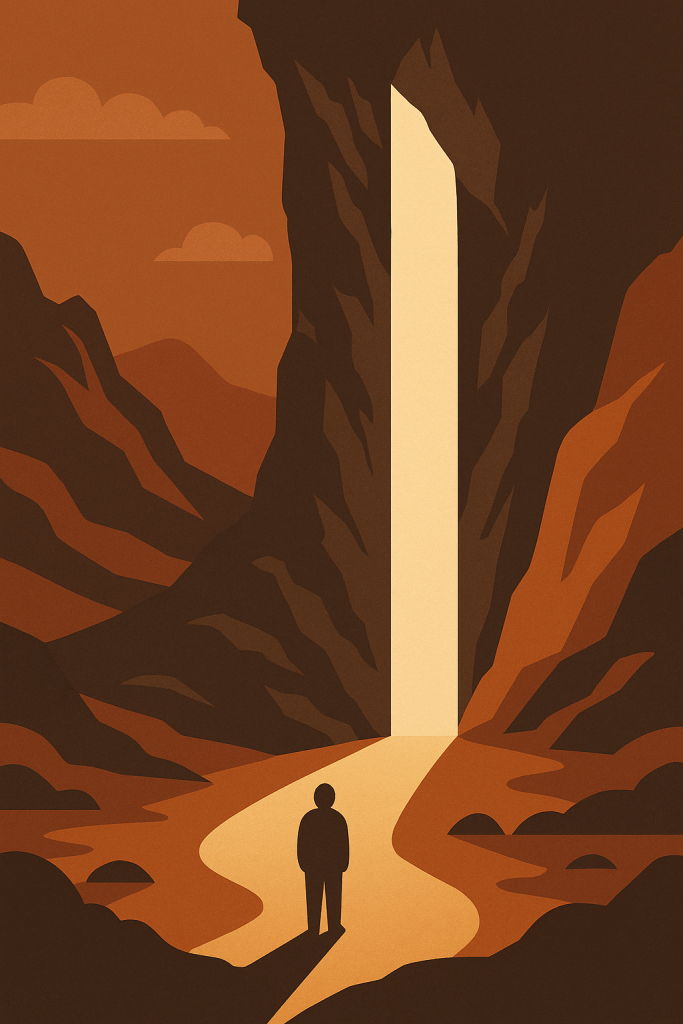
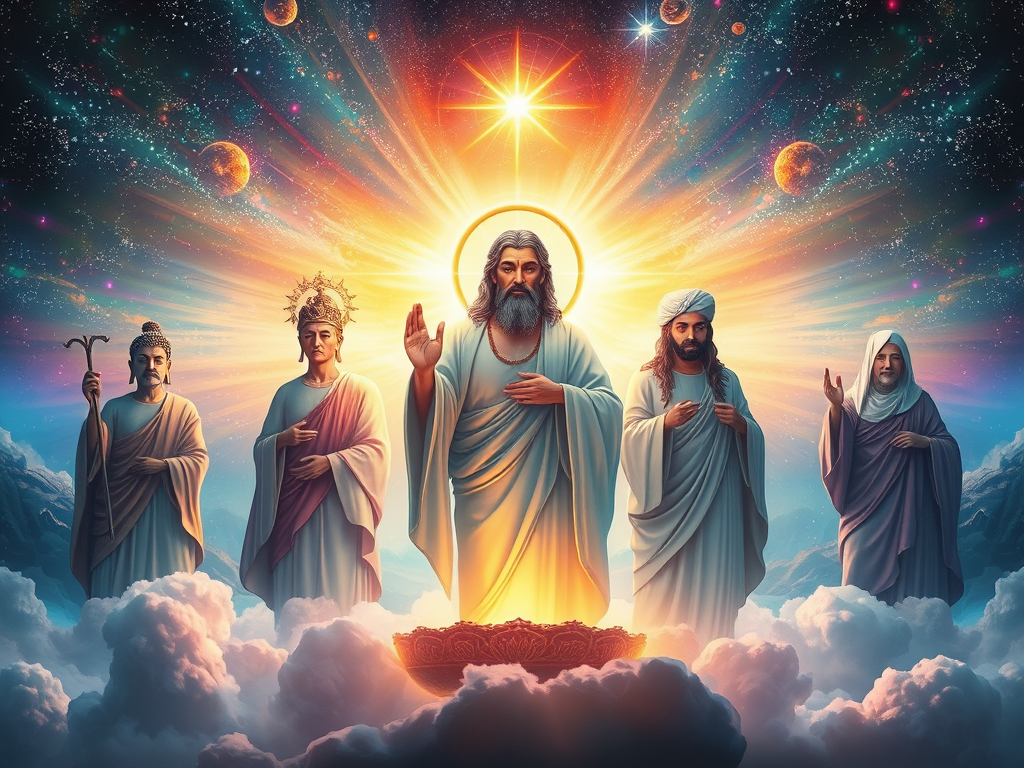
Every seeker, whether they swing a rock hammer or carry a prayer, eventually finds themselves standing before a threshold—the kind that makes the heart hesitate and the mind scramble for footing. It’s the moment when the familiar gives way to something larger, older, deeper. And it’s there, in that quiet tremor, that three voices from three very different ages speak in harmony.
Bahá’u’lláh writes in the Hidden Words:
“O children of the divine and invisible essence! Ye shall be hindered from loving Me… minds cannot grasp Me nor hearts contain Me.”
Not as a warning.
Not as a scolding.
But as a gentle acknowledgment of the human condition:
we tremble at the presence of the Infinite.
Marcus Aurelius, with his blunt Roman clarity, put it another way:
“What stands in the way becomes the way.”
(Or in its modern phrasing: “the obstacle is the way.”)
Resistance is not a sign to retreat—it is evidence that we’ve reached meaningful terrain.
And then there’s Oriah Mountain Dreamer, calling from the raw, human center of things. In The Invitation, she slices through every superficial layer and asks the single question that matters:
Can you sit with the ache without fleeing?
Can you stay present at the edge of your own fear?
Different languages.
Different centuries.
Different traditions.
Yet they point to the same spiritual topography.
We are not hindered from the divine because we are unworthy.
We are hindered because to stand before the Unknowable is to feel the fault lines within ourselves shift.
That trembling is natural.
It is ancient.
It is sacred.
And perhaps most importantly: it is an invitation.
The Fear Isn’t a Sign of Distance — It’s a Sign of Proximity
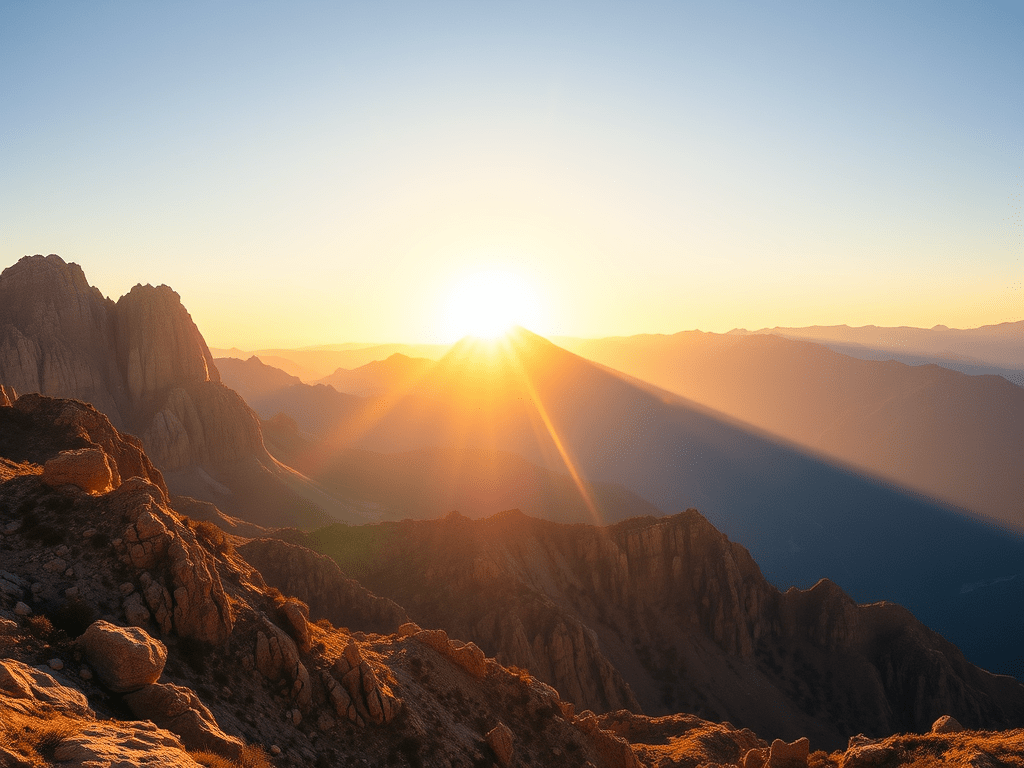
Many people recoil from the word “God,” not because the syllables are flawed, but because the concept feels like standing at the edge of a canyon whose far wall is lost in the morning haze. There’s weight there. Mystery. Depth. Responsibility.
You could swap out the term—call it the Universe, the Divine, the Source, the Infinite—but the human soul would still quiver when it approaches something vast. The resistance isn’t linguistic; it’s existential.
We hesitate in the presence of something that promises to remake us.
And that is precisely what Bahá’u’lláh names:
You will be hindered—because your very finiteness recoils at infinity. That recoil is not sin. It is simply truth.
Marcus Aurelius echoes it through the Stoic lens:
What blocks you becomes your teacher.
Oriah extends the same insight into relationship:
Show me you can remain open in the face of discomfort. That’s where real life begins.
These aren’t contradictions.
They’re harmonies.
A Geological Parallel: Where the Earth Breaks, the Veins Form
As a geologist, I see this pattern play out in the crust of the Earth itself.
The richest mineralization often forms along fractures.
The most meaningful structures occur where rock gave way.
The story is written in the breaks, not the unbroken slabs.
Pressure + heat + time = transformation.
Always.
Human souls aren’t all that different.
Where we meet resistance—fear, doubt, hesitation—that’s where the vein runs. That’s where the treasure lies buried. The obstacle isn’t an impediment. It’s a compass needle pointing toward the work that matters.
Bahá’u’lláh, Marcus, Oriah—each is describing the same metamorphic process.
Why This Matters Today
We live in a secular, scientific age that prizes measurement and control. As a scientist myself, I treasure those tools. They illuminate the physical world with astonishing clarity.
But they cannot fully speak to the subterranean dimensions of the human spirit.
When people bristle at “God,” it’s not science speaking—it’s vulnerability. To approach the Infinite is to admit that not everything fits into an equation, that mystery still pulses through the universe, that meaning is not always quantifiable.
It’s easier to stay on the surface.
It’s safer there.
But no mineral worth finding ever sits on the surface for long.
The Real Work: Helping Others Cross Their Threshold
If you want to help others see what you’ve seen—to feel what cracked open your own heart—don’t focus on finding a “better word.” Focus on creating space for the trembling.
Speak not from doctrines but from transformation.
Share not certainties but wonder.
Offer not explanations but companionship at the edge of the unknown.
Because here’s the hidden truth:
The fear people feel around the Divine is not a flaw—it is proof they are standing at the doorway.
And the trembling is not a warning to retreat.
It is the ancient signal that they are finally, beautifully, achingly close.
The obstacle is the way.
The doubt is the invitation.
And the trembling is the threshold of awakening.






 the musing geologist